













This entry contributed by Nicolas Bray
In general, a graph product of two graphs G and H is a
new graph whose vertex set is 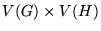 and where, for any two vertices (g,
h) and
and where, for any two vertices (g,
h) and  in the product, the adjacency of those two vertices
is determined entirely by the adjacency (or equality, or non-adjacency) of
g and
in the product, the adjacency of those two vertices
is determined entirely by the adjacency (or equality, or non-adjacency) of
g and  ,
, .
. cases to be decided (three possibilities for each,
with the case where both are equal eliminated) and thus there are
cases to be decided (three possibilities for each,
with the case where both are equal eliminated) and thus there are  different types of graph products that can
be defined.
different types of graph products that can
be defined.
The most commonly used graph products, given by conditions sufficient and necessary for adjacency, are summarized in the following table (Hartnell and Rall 1998). Note that the terminology is not quite standardized, so these products may actually be referred to by different names by different sources (for example, the graph lexicographic product is also known as the graph composition; Harary 1994, p 21). Many other graph products can be found in Jensen and Toft (1994).
| graph product name | symbol | definition |
| graph Cartesian Product |  |
( and and  ) or ( ) or (  and and  ) ) |
| graph categorical Product |  |
( and ) |
| graph lexicographic product |  |
( ) or ( and ) |
| graph strong product |  |
( and ) or ( and ) or ( and ) |
 Graph
Cartesian Product, Graph
Categorical Product, Graph
Composition, Graph
Lexicographic Product, Graph Strong
Product, Graph
Sum
Graph
Cartesian Product, Graph
Categorical Product, Graph
Composition, Graph
Lexicographic Product, Graph Strong
Product, Graph
Sum



Harary, F. Graph Theory. Reading, MA: Addison-Wesley, 1994.
Hartnell, B. and Rall, D. "Domination in Cartesian Products: Vizing's Conjecture." In Domination in Graphs--Advanced Topics (Ed. T. W. Haynes, S. T. Hedetniemi, and P. J. Slater). New York: Dekker, pp. 163-189, 1998.
Jensen, T. R. and Toft, B. Graph Coloring Problems. New York: Wiley, 1994.

 | |||
 |
 | ||